How to Buy a Matching Set You Will Actually Wear Both Halves Of
Quick Answer: Ask whether each half would earn a place in your wardrobe on its own, at that price, without its partner. If either answer is no, you are buying one piece and paying for two. The sets people wear for years are the ones where both halves are independently strong and the pairing is a bonus - not the ones where a plain bottom is carried by an interesting top. Try each half against something you already own before you decide.
The set looked perfect on the hanger and perfect in the mirror.
Six months later the top is in weekly rotation and the bottom has not left the drawer.

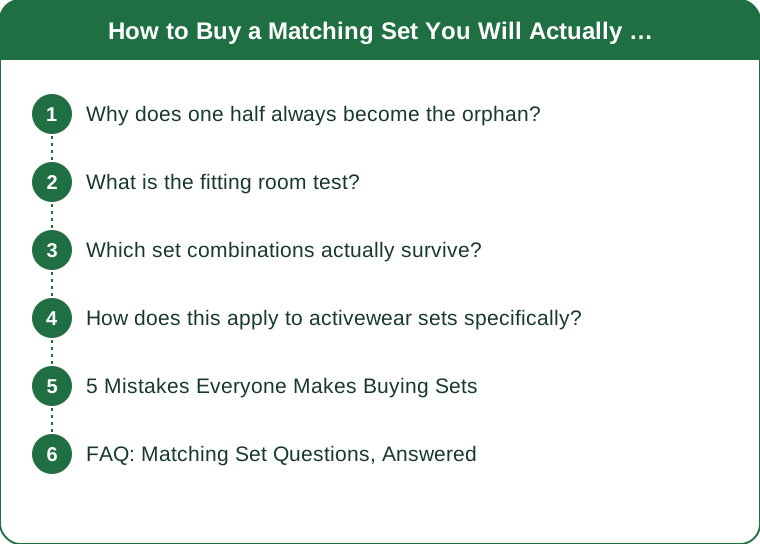
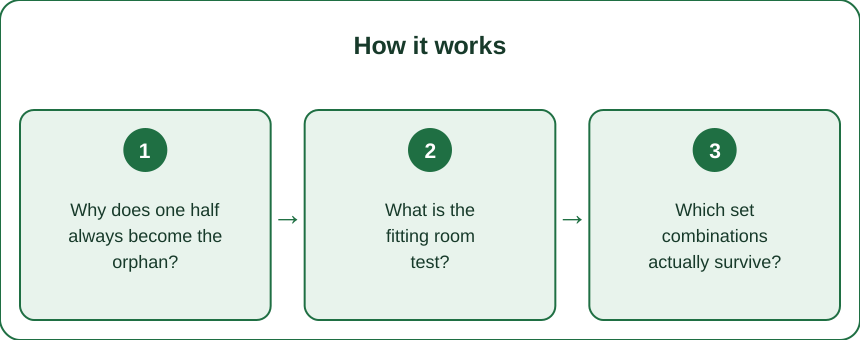
Why does one half always become the orphan?
Because sets are usually designed with a hero piece. One half carries the design interest and the other exists to complete the look, and it is almost always the bottom.
The hero piece has independent appeal, so it gets worn with everything. The supporting piece was designed to be a background, and a background piece has to be genuinely excellent to survive on its own.
Colour is the other trap. A distinctive colour that works beautifully as a full look is often difficult to pair with anything else, which strands both halves outside of matched wear.
Fabric weight mismatch does it too. If the top is a lighter or heavier weight than the bottom, they read as separates from different outfits when worn apart.
And matched wear is more occasional than people plan for. Most people wear a full set less often than they imagined at purchase, which means the halves need to work alone most of the time.
The prediction is available before you buy. You just have to ask the question in the right order.
What is the fitting room test?
Try each half alone, with something of your own, before you try them together. This is the whole test and almost nobody does it in this order.
Bring a plain top and a plain bottom with you - or use what you wore into the shop. Judge the bottom against your own top, and the top against your own bottom.
Score each half independently: would you buy this alone, at roughly half the set price, today?
Two yes answers means buy. One yes and one no means you are paying full price for one piece - which is sometimes still worth it, but now you know.
Two no answers means the appeal was the styling of the display, not the garments.
Then try them together last, because trying them together first anchors your judgement and makes the weaker half look better than it is.
Which set combinations actually survive?
A strong neutral bottom with an interesting top is the most durable pairing, because neutral bottoms have unlimited independent use.
Matched texture in a solid colour works well because texture reads as intentional whether paired or separated.
Same-fabric sets in a wearable colour - a rib knit set in oatmeal, black or a muted green - tend to be worn more than the equivalent in a statement shade.
Sets where the pieces are different lengths than your existing wardrobe fill an actual gap, which is the strongest argument for any purchase.
What survives least: loud print sets, sets with contrast trim that only makes sense together, and sets where the top is cropped to exactly the rise of its own bottom and nothing else.
And a specific caution on ribbed sets: rib knits often relax at different rates in the top and bottom depending on how much tension each sees, so a set that matched perfectly in month one can drift by month six.

How does this apply to activewear sets specifically?
Activewear sets have the same problem with an extra layer, because performance requirements differ between top and bottom.
The bottom takes far more stress than the top - more stretch, more abrasion, more washing - so it wears out faster and the set becomes mismatched even when both are still good.
Buy the bottom on its own merits as a legging or short, ignoring the set entirely, because that is where the money should go.
Check whether the top works over other bottoms in your drawer, particularly at different rises. A top cut for a high-rise partner sits oddly over a mid-rise.
Colour matching degrades with washing, especially in blacks and brights, so two pieces washed at different frequencies will not stay the same shade.
And consider buying two of the bottom if the set is genuinely good. It is the piece you will wear out first and it is the piece you will not be able to replace once the colour is discontinued.
5 Mistakes Everyone Makes Buying Sets
1. Trying them on together first. The full look is persuasive and it borrows credibility for the weaker half. Judge separately, then together.
2. Buying for the mirror rather than the drawer. A set that photographs beautifully and duplicates three things you already own will not get worn, however good it looks in the fitting room.
3. Ignoring the rise-to-hem relationship. A crop top designed around one specific waistband height is a top that only works with that waistband. Check it against two of your own bottoms.
4. Assuming both halves fit the same size. Set sizing is a compromise, and a large proportion of people need different sizes top and bottom. Brands that sell halves separately are quietly telling you this.
5. Buying the statement colour first. Almost everyone’s first set is the striking one and almost everyone’s most-worn set is the neutral one bought second. If you are buying one, buy the second one first.
And the honourable mention: not checking the care labels against each other. If one half is machine washable and the other says hand wash, you already know how that ends.
FAQ: Matching Set Questions, Answered
Are matching sets still in style?
Sets have been a durable category rather than a passing trend for several years, especially in knit and activewear. The style risk is in the specific colour or print, not in the format.
Should the top and bottom be the same size?
Only if your body is the same size in both, which is not the norm. Buy each half to fit if the brand sells them separately; if not, prioritise fitting the bottom well.
How do I stop the two halves fading differently?
Wash them together, cold, inside out, and air dry. Most colour drift between halves comes from one piece being washed twice as often as the other.
Can I wear a set as separates in the office?
Usually yes, and it is the strongest argument for a neutral set. A ribbed knit top or a well-cut bottom reads as a separate the moment it is paired with something else.
What is the best colour for a first set?
Something you already have a lot of in your wardrobe, because that guarantees both halves have partners. Black, charcoal, oatmeal and olive all do this well going into autumn.
Is a more expensive set better value?
Only if both halves pass the independent test. An expensive set with one orphan half is worse value than a cheap set with two wearable pieces.
TL;DR:
- Ask whether each half earns its place alone, at half the price, before you consider the pairing.
- Try each half against your own clothes first, and try them together last.
- Neutral bottoms and interesting tops is the most durable combination.
- In activewear, the bottom takes far more wear, so buy the bottom on its own merits.
- Set sizing is a compromise and many people need different sizes top and bottom.
- Wash both halves together to stop the colours drifting apart.
Buy two pieces you want, not one piece with a companion attached.
Keep Reading
This article is for general informational and styling purposes only. Fit, sizing, and product availability may vary.