Why a Matching Set You Love in the Mirror Feels Wrong Two Hours Later
Quick Answer: A matching set is judged standing still and worn in motion. Over a couple of hours, body heat relaxes the fabric, the waistband migrates, the top rides up, and the gap between the two pieces changes - which is the exact detail that makes a set look intentional or accidental. Sets fail at the meeting point, not at either garment. Test the transition, not the pieces. The mirror shows you minute one; buy for hour two.
The two pieces are usually fine.
The inch between them is where the whole thing is decided.


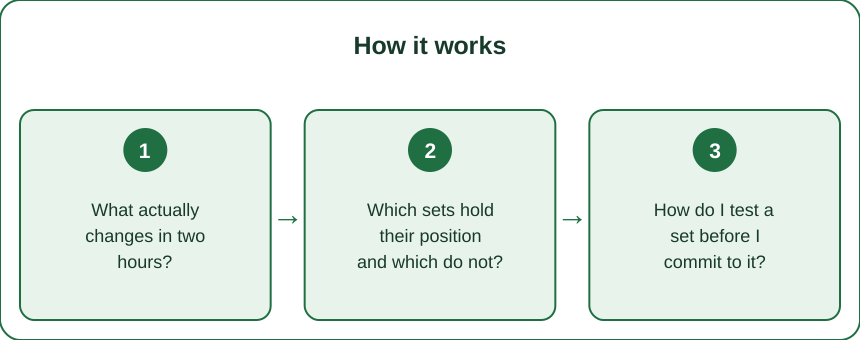
What actually changes in two hours?
Four things, all predictable.
The fabric warms and relaxes. Elastane loses some of its tension as it reaches body temperature, so a set that was snug at room temperature is slightly looser twenty minutes in. This is normal and by design.
The waistband migrates. A high waistband sits above the natural waist, which is the narrowest point - and gravity plus movement gradually pulls it toward wider ground. Rolling is the waistband finding a more stable position, not a manufacturing failure.
The top rides up. Arm movement pulls a cropped top upward with every reach, and there is nothing anchoring it. Over two hours of ordinary activity that adds up to a couple of inches.
Both moving in opposite directions widens the gap. The waistband descends and the top climbs, and the exposed strip between them grows. A set designed with a one-inch overlap can end up with two inches of gap.
And your body changes slightly through the day too. Bloating, temperature, and posture all affect how a close-fitting garment sits, and the same set genuinely fits differently at 8am and 4pm.
None of this is a defect. It is what happens to any two close-fitting garments worn in motion - and it is entirely predictable, which means you can buy for it.
Which sets hold their position and which do not?
Five features that predict whether the transition survives.
Waistband width and construction. A wide waistband distributes pressure over more area and rolls far less than a narrow one. A band with an inner grip strip or a bonded construction holds better than a simple elastic casing.
Overlap at rest. A set where the top overlaps the waistband by at least two inches standing still has margin for the drift. Anything that just meets will separate within the hour.
Top length relative to the ribcage. A top that ends below the ribcage stays put better than one that ends on the ribs, because there is nothing for it to slide over.
Fabric weight, in the right direction. A slightly heavier top resists riding up because its weight works against the upward pull. Ultralight cropped tops are the most prone to migration.
A grip element somewhere. Silicone strips at the hem, a snug band, or a slightly textured fabric all reduce sliding. Smooth-on-smooth is what moves.
And the fit of the leggings at the waist matters more than the leg fit. A legging that is loose at the waist and snug at the thigh will roll no matter what the waistband is like - the waist has to be the anchor point.

How do I test a set before I commit to it?
Four movements, in the fitting room, in under a minute.
Reach both arms overhead and hold for five seconds. Then lower them and look at where the top has settled. If it does not return to roughly where it started, it will keep climbing all day.
Do a full squat. This tests the waistband and the top simultaneously - the waistband will show whether it rolls at the front, and the top will show whether the back rides up.
Bend forward at the hips. This is where a set most often reveals a gap at the lower back, and it is the position you spend more time in than you realise.
Walk for thirty seconds. Most fitting-room decisions are made standing still, and walking reveals waistband migration that standing does not.
Then check the overlap again. If after all four movements the top still overlaps the band, the set will hold up. If it does not, it will not - and no amount of adjusting through the day will change that.
And check it sitting down. The waistband under a seated posture is where rolling starts for most people, and a set worn to a desk faces this for hours.
5 Mistakes Everyone Makes Buying a Set
1. Judging it standing still, facing forward. The one position you spend the least time in. Every fit problem in a set appears in motion.
2. Buying the top and bottom in the same size automatically. Most bodies are not the same size top and bottom, and a set that lets you mix sizes is worth more than one that does not. A top that is slightly too small is the single most common cause of riding up.
3. Choosing the shortest crop available. Every inch of length is margin against the gap widening. A slightly longer top gives you two hours instead of twenty minutes.
4. Ignoring the waistband height relative to your torso. A high-rise legging on a short torso sits at the ribcage and there is nowhere for a cropped top to go. This mismatch is the cause of more set failures than any fabric issue.
5. Buying for the photo rather than the day. A set that photographs beautifully in a held pose can be unwearable in motion - and the reverse is also true. Decide which one you are buying for.
And the one that catches people out in autumn: not checking it under a layer. A set worn under an open jacket or oversized sweatshirt behaves completely differently - the extra fabric pushes the top up and the layering changes the whole proportion. If you will wear it layered, try it layered.
FAQ: Matching Set Fit Questions, Answered
Should I size up or down in the top?
Size to the fit that stays put through the overhead reach test. A too-small top rides up; a too-large top slides and bunches - and of the two, too small is the more common purchase and the more visible problem.
Why does the waistband roll on me and not on my friend?
Torso length and waist-to-hip ratio. A pronounced waist-to-hip difference gives the band more to slide down, and a shorter torso puts a high-rise band higher on the ribcage where it is less stable. It is a fit interaction, not a quality difference.
Do sets ride up more as they age?
Yes. Elastane recovery declines with wear and washing, so an older set holds position less well - and the waistband, being the most stretched component, goes first. Cold washing and air drying meaningfully slows this.
TL;DR:
- Fabric relaxes, the waistband descends, and the top climbs - the gap between them widens over about two hours.
- Sets fail at the meeting point, not at either garment.
- Buy at least two inches of overlap standing still, a wide waistband, and a top that ends below the ribcage.
- Test with overhead reach, a squat, a forward bend, and thirty seconds of walking before you buy.
- Mix sizes if the brand allows - most bodies are not one size top and bottom.
Do the overhead reach test on the set in your drawer right now. If the top does not come back down, you have found why it never feels right by mid-morning.
See It in Motion
Seen here: Super High Waist Embossed Yoga Leggings with Inner Pocket — shop it on bubblelime.com
Keep Reading
This article is for general informational and styling purposes only. Fit, sizing, and product availability may vary.